
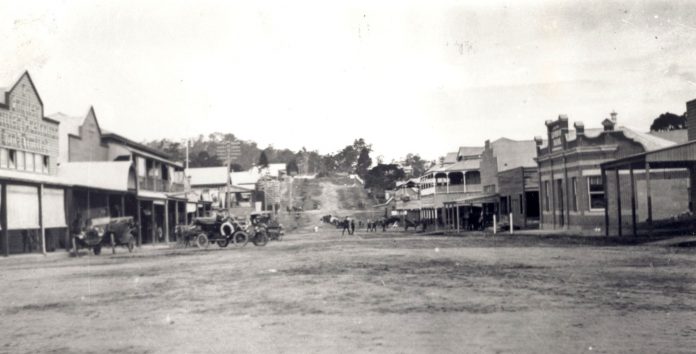
In January 1870, Matthew Carroll took up the first selection, an area of some 40ha near today’s Nambour Showground and that was the beginning of what was to be the region’s major commercial centre for more than a century.
Carroll first used his selection for timber but he later turned to farming and in 1884, opened the settlement’s first business, a hotel, on showground hill.
Meanwhile, William Samwell had made his selection two months after Carroll, in March 1870. He called it Naamba, an Aboriginal word meaning red flowering ti-tree or its bark.
The settlement was known as Petrie’s Creek until, in 1872, Samwell referred to Nambour, an Anglicised version of Naamba, in a letter to the Lands Department.
The first building for white settlers went up in 1870 when Samwell provided accommodation for workers he had contracted to fell scrub. It was near their work site, where the Nambour Railway Station now stands.
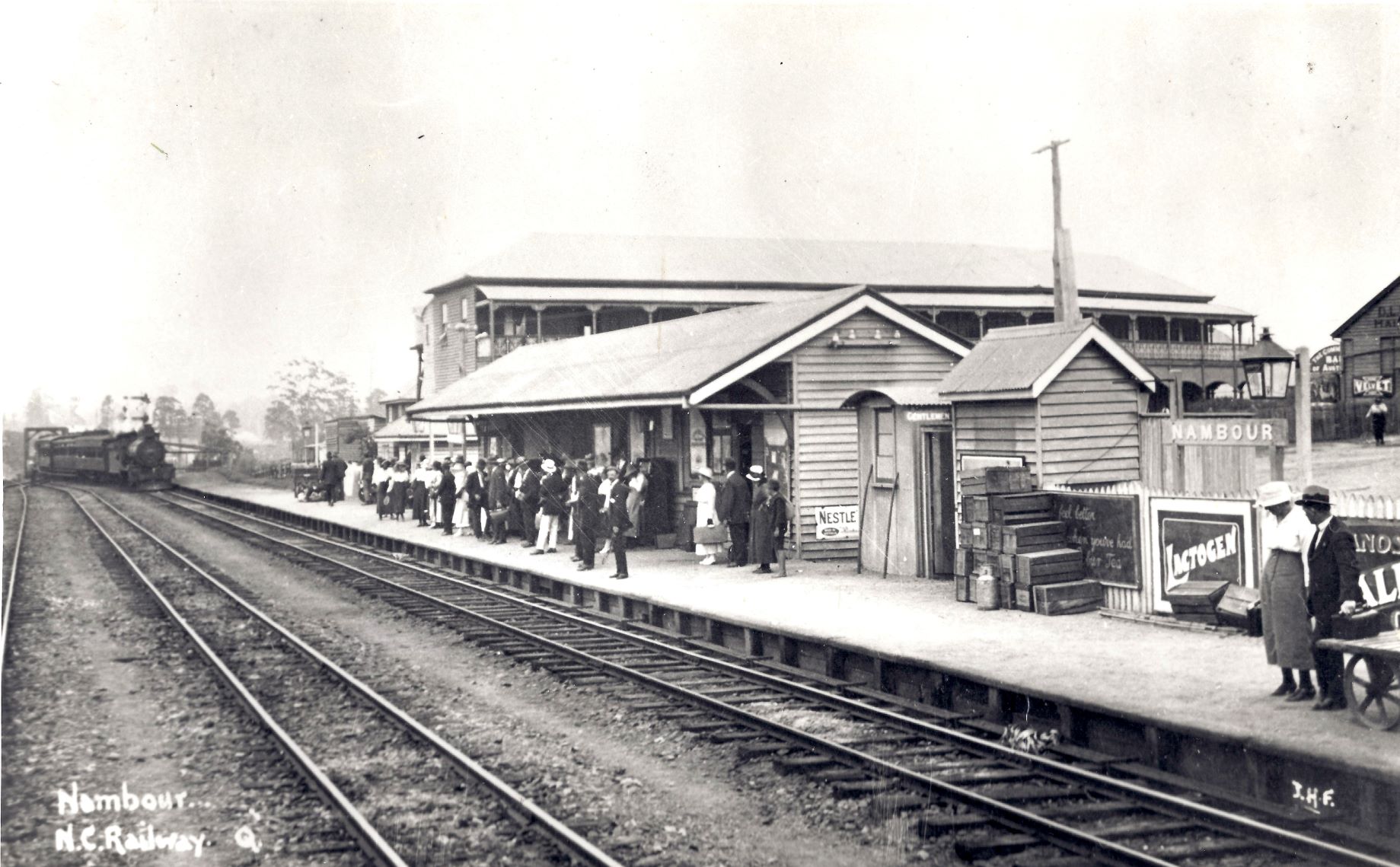
The remainder of the Petrie Creek valley was selected during 1878-80 but it was the railway line that really sowed the seeds for a new town.
When the line opened in 1891, Petrie’s Creek was officially re-named Nambour.
Until then, despite its position at the centre of the most fertile part of the region, it had been competing with the Cobb and Co depots of Woombye and Yandina.
Carroll built a new hotel where the Commercial Hotel now stands, and the town started to take shape.
The Currie family, who in 1896 gave their name to the main street until then called Gympie Road, were commission agents and owned the first general store in Nambour, a butcher’s shop and later the pub.
Its name was changed from Carroll’s Petrie Creek Hotel to Currie’s Nambour Hotel.
John Currie, a member of the committee chosen to name the Nambour streets, called it after his father, Daniel, a native of Illinois in the US who had moved from Victoria when his luck ran out on the goldfields.
In 1882, Daniel Currie had selected 259ha which he called Bundara, and developed an orchard. His home was built in the area now known as Magnolia St.
The first post mistress was Ann Jones whose husband George became the first clerk of the forerunner to the Maroochy Shire Council, the Maroochy Divisional Board, which was formed in July 1890.
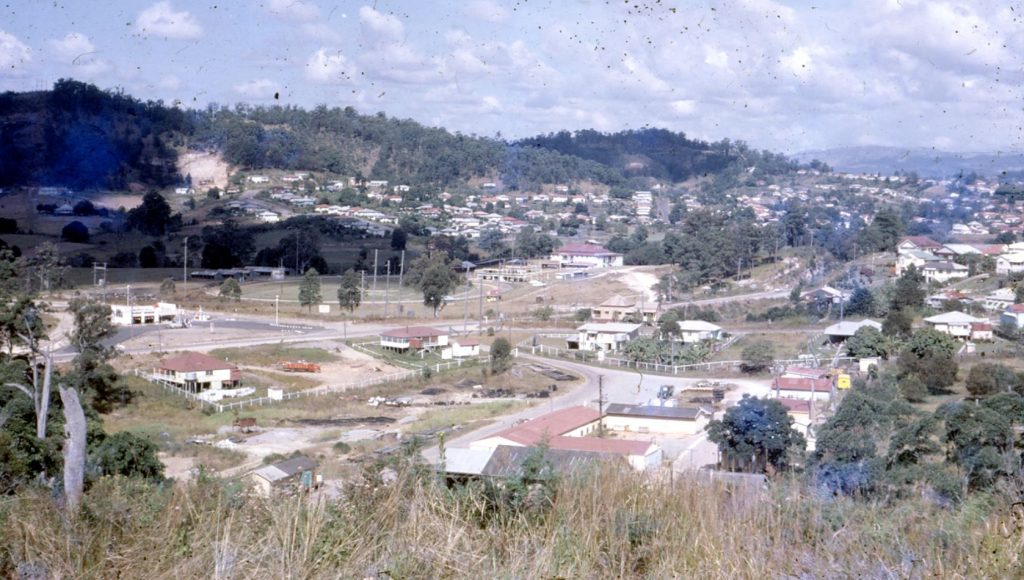
The sugar mill played a big part in Nambour’s development from the day the company was formed in December 1894, Daniel and John Currie holding 3625 shares. The first cane crush followed three years later.
In addition to its large staff which greatly expanded the town, it formed the basis of a town-dwelling population.
By 1895, Nambour had a population of 150, but this had doubled by 1899 and at the turn of the century, there were 350 people.
This meant the introduction of services such as a doctor, pharmacy and a solicitor but more importantly, that people came to Nambour to do business. The first newspaper, the Nambour Chronicle, opened in 1903.
Love history? So do we. Help keep more great Coast memories alive by subscribing to our free daily news feed. Go to Subscribe at the top of this story and add your name and email. It’s that simple.
The population reached 1000 in 1910, but slowed during World War I, then grew to 2800 by 1927.
From then, about 1000 people a year moved to the thriving commercial centre, where people from Noosa and Kenilworth, to Palmwoods and Eudlo and the coastal centres, came to do their shopping and banking.
Once roads began to improve in the 1930s the first chain stores and specialty shops also came to Nambour and with the hospital, shire chambers and major school, it became the commercial heart of the Sunshine Coast until the turn of the millennium when Maroochydore was declared the new CBD.
This flashback is brought to you by veteran Sunshine Coast journalist and history writer Dot Whittington, also the editor of Your Time Magazine.